


Councillor candidates answer questions during event held in McGregor

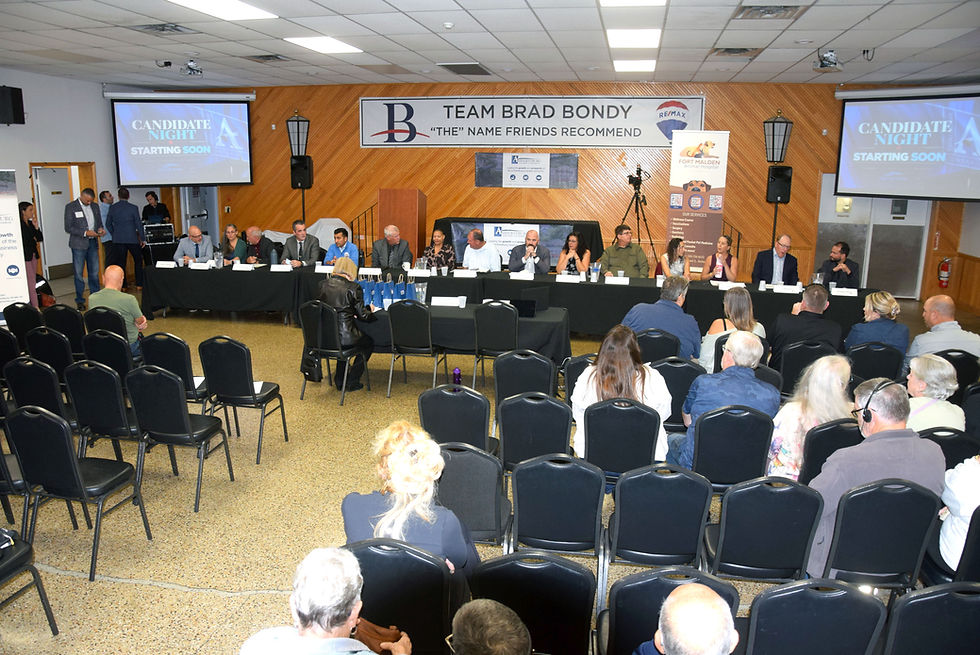
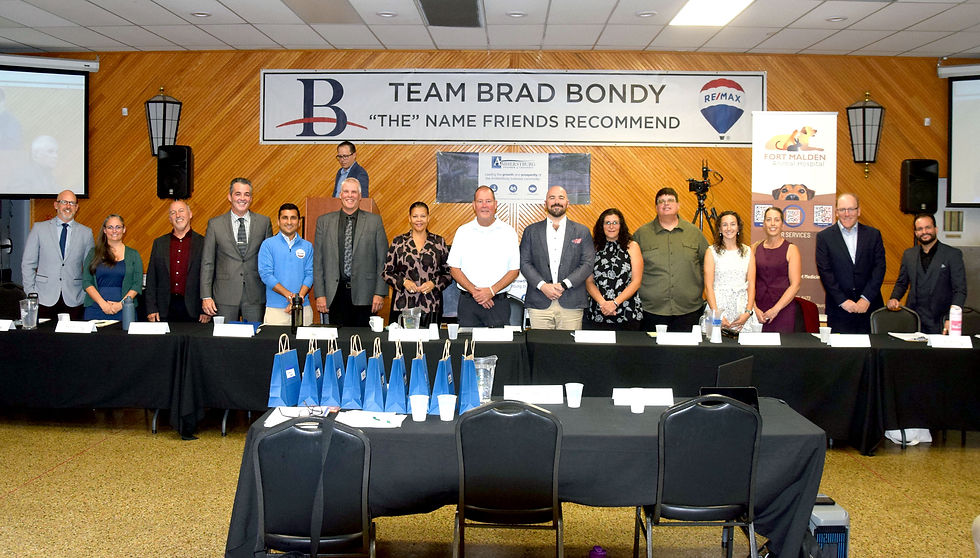
The Amherstburg Chamber of Commerce (ACOC) hosted the first two all-candidate nights Oct. 7 with the councillor candidates taking centre stage.
The 15 candidates for councillor – Shawn LeBlanc, Stephanie Pouget-Papak, Keith Boussey, Wes Ewer, Dhaval Prajapati, incumbent Peter Courtney, Sonya Elliott, Frank Cleminson, Armand Anderson, Lena Lazanja, Lorne Dupuis, incumbent Molly Allaire, Jen DeLuca, T.J. Botsford and Saurabh Katara – fielded questions from moderator Michelle Maluske from CTV Windsor at the McGregor Columbian Club.
There were five rounds with three candidates fielding the same question per round until all candidates received a question. The question-and-answer period followed opening statements from the 15 candidates.
The first candidate to field the question of what services could be cut if council chooses to cap taxes went to Botsford. He said taxation is a big issue when knocking on doors. Finding a balance when budgeting is key, with some people having the idea of a zero-based budget. Wise spending and responsible growth are the ideal way to move forward.
Boussey said he wants to look closer at the town’s financial numbers and study the costs of items. He wants a more comprehensive look at the books, see what is spent and try to maintain services.
DeLuca said she didn’t believe that services would have to be cut to create savings. She said she wanted to look at each budget item line-by-line, perhaps try something differently but make do with what the town has.
The question of holding council and administration accountable to achieving milestones in the town’s strategic plan was first posed to Ewer. Ewer said if the town has plans and budgets, it should stick to them. Ultimately, the residents hold everyone accountable as he said they are all shareholders in a $65 million corporation. He said the town needs to stick to the plans it has, questioning what the point of the plan is if they are not sticking to it.
Allaire agreed the town needs to stick to its strategic plan, noting all council reports show where that item fits within the plan. She added when council gets its agenda, she works with administration and asks questions so staff has time to find answers and solutions. Working together is the only way the plan can be successful, she added.
Prajapati said many organizations have strategic plans and progress always has to be measured on how it is going. He said “we all have to follow the proper plans” and milestones have to be hit to ensure that the ultimate goals are being hit.
Policing was the subject of the next question, with Dupuis being the first to answer it. He said that while many believe the OPP is the best option, there are still other avenues that could be explored. He believed the town could do more with less and wondered if a more financially viable way of bringing back the Amherstburg Police Service could be developed. He believes he could help find a solution with the help of others.
Courtney said the town actually has to listen to what residents want, recalling switching from Amherstburg to Windsor hinged on one vote.
“We gave away everything, including the paperclips,” said Courtney.
Courtney added there was not enough time for LaSalle to consider a combined force and no interest in a regional force, adding that a service model has to be looked at for the OPP.
Lazanja added she sat on the chief’s advisory board in 2018 when the switch happened, and recalled the board going through its budget line-by-line. She said they have to look at all options, and get an options residents need and want.
“When it comes to policing, we have to look at the safety of our town,” she said.
Whether or not tourism was viewed as an industry that needs to be nurtured to enhance it as an economic driver was asked, with Elliott being the first to answer. She said the town has good tourist events, and “if we want to, we could add on.” She believed the town could use more, suggesting more events involving food trucks, and that more could be done for families as well as having mid-week events.
Anderson pegged the tourism budget at $750,000 or $7.5 million over ten years, and questioned what the return on investment was. He said tourism is driven by commerce and said businesses draw more commerce to town than festivals. He suggested the town get “out of the way”, let them put their signs up and let them do what they do best.
Cleminson said it was an issue near and dear to him, noting there are AirBnB’s and a need for a hotel. There are historical sites and sporting events and the town needs to work with businesses to see what they need so they can do their jobs. He said all businesses need to be listened to and the town needs to give them the tools they need to grow. When they grow, the town could invest further more into tourism, suggesting they continue to build onto the King’s Navy Yard Park.
Access to the water, such as a public boat launch was a question for Katara. He said that would be a project to look at closely, but pointed out the need to look at all the facts, the evidence and study the numbers. He said if the numbers made sense to him, he would vote for it.
Pouget-Papak said she loves to fish and people have a right to be able to access the water. Location is a factor, she said, preferring a boat launch on the outskirts of town. She also said there are times when the Detroit River can be dangerous, so it has to be clear what types of crafts can be launched. Council also has to determine where the money would come from to pay for it.
Botsford added another factor to the boat launch debate, that being the roads. He said additional traffic and trailers could hurt the roads. He also noted there can be dangers on the river. A transient marina would be a great asset, he added, but the question is how that would be funded.
The meaning of accountability was another question with Boussey stating it centres around respecting the community and being willing to listen to what the residents want and need. The voters have to be heard before council casts a vote on an issue and try to find a compromise that works for everyone.
DeLuca said accountability is a way of life for her and said she would not be able to look herself in the mirror if she was dishonest. She suggested having a question period at council meetings so that resident can access council members and feel heard.
Ewer said council has to make decisions for the betterment of the community. He said he would come ready to listen and have the tough conversations. After difficult discussions, the goal would then be to compromise. He added residents want to be heard.
Candidates were also asked what sets them apart from their colleagues. Allaire said she has four years of experience and that this term of council has seen her include her children on some of the events she attends so they can see what she does. Recalling that she campaigned as a fresh voice four years ago, she said she has gained experience at the council and ERCA levels and that choices made there impact entire communities.
Prajapati said he is continuing to learn about the town and share that with others, citing is “100 Days, 100 Stories” initiative on his campaign social media pages.
“I share the Amherstburg stories that I see from my eyes,” said Prajapati.
Prajapati added he is aiming to bring a new perspective to the town council table.
Dupuis said he has started companies and built them up and that is a skillset he believes he can bring to council. He referenced his earlier comment about being “a serial entrepreneur.”
A main goal or positive impact candidates want to have, if elected, was first given to Courtney. He said “my goal is your goal” and that he wants to listen to the residents. Thoughtful growth is important, he said, as the town has to maintain its small town charm.
“The secret is out – Amherstburg is the best town in Windsor-Essex,” he said.
Lazanja said uniting the town is a goal for her, stating Amherstburg has gone from a town that was together to a town that is divisive.
“That’s not a good feeling,” said Lazanja.
Lazanja said she wants a town where her children can stay in long-term and have the town be one where it supports one another.
“My goal is to have the community stick together, work together and listen,” said Elliott.
Elliott added she wants to see the community take time for each other and to “enjoy the community.” She said she wants to tell others what a great community Amherstburg is and wants to see everyone in town respected.
Using reserves to lower the tax rate was another question, with Anderson sayingprudent budgeting is what is required. Having discipline and proper planning is needed, and without conscious budgeting “you will not have a good financial outcome.”
Cleminson said he would not agree to go into reserves. He said that money is set aside and it has to be used properly. In cases of emergency, reserve funding could be used, but he didn’t think reserves are the answer to be used for shortcomings or not planning properly. He said they have to have a budget they can live within.
LeBlanc recalled over a decade ago when the town had little in reserves and didn’t want to entertain going back to those days. Sticking to the strategic plan and not looking at short-term gain is key, as the town has to ensure it flourishes in the future as well.
It is also nice to have “a rainy day fund” in case it is needed, LeBlanc added.
Providing basic needs and services to those below the poverty line was asked, with Pouget-Papak stating that is an issue she sees a lot of in the school system too. Supporting food banks and those in need is important and government needs to look at the level of support it provides. She added housing is “a very large issue” that involves multi-layers of government and she said the town should work with upper levels of government to see what can be accomplished.
Botsford also said one of the town’s strategic plan pillars deals with this issue. Diversified housing is needed in Amherstburg, he said, and pointed out the housing planned by Habitat for Humanity in the community. He also pointed out the programming offered by the town, some of it free of charge, for seniors and youth in the community.
Boussey said there are lower income families in need, noting there are children and youth who can’t afford such things as playing in sports. He recalled being part of organizations where subsidies helped youth enrol and looked for programs like that to continue. There is a need for the community to come together and help provide assistance for others, including helping with fundraisers and donations.
Policing services and whether Windsor is still an option was addressed. DeLuca said all options should be considered and that includes service levels and costs. She stated she would like to have additional conversation with Windsor about policing and the input of residents is also very important. There is a need for safety; it’s not simply about the cheapest option.
Ewer said he is “cautiously leaning” towards going with the OPP. The level of service is also a question for him and he wondered about going back to Windsor and negotiating prices and what services the town would need and for what cost.
“Let’s get creative of what we ask of them,” he said.
Allaire said it is an issue that will be decided by the next council but public comment will be sought as part of the process. She said the cost for Windsor police right now is about $6.9 million per year while OPP could be $3-4 million based on other prices within the region.
“I want to make sure to listen to everyone and have public conversations,” said Allaire.
The next question for candidates was what is the best selling feature of Amherstburg for potential investors with that posed to Prajapati, Dupuis and Courtney.
Prajapati spoke of Amherstburg’s industrial history and that wanted that to be pursued harder. The town needs to be marketed and said that work needs to happen now so that results can occur in the future.
Quality of life was something Dupuis found to be a selling point for Amherstburg, stating the town is “fantastic” and surrounded by water. Amherstburg would be a great place for employees to locate, he said, and called for a subcommittee to attract business. He also recommended lobbying the province for tax incentives to bring in business.
The town’s geographic location is a selling point for Courtney, noting the town is an international border town in close proximity to border crossings including the newly opened Gordie Howe International Bridge. He said there are lands with rail and port services, there is the Howard Industrial Lands, and agencies like TWEPI and Invest Windsor-Essex the town can utilize.
Concerns over the yet-to-be completed fire hall and how to relay information to the public was raised. Lazanja said contracts need to be reviewed as part of letting the new council and the public know how things got to this point. She called for “air tight” contracts in the future and she noted she met with firefighters recently, some who had “mixed emotions” about the need for it in the first place.
Elliott said she has spoken to numerous people who are concerned about the fire hall progress. She said she can’t give a lot of answers but while it is a “beautiful building,” she hasn’t seen a lot of activity. She said they have to talk to the community, find out how long it’s going to take and cost. Elliott said it’s in town “but a little out of town,” citing traffic concerns in town.
“We’re all going to have to sit and wait and see what happens,” said Elliott.
Anderson said he addressed issues such as ambition and buying what the town needs versus wants. He said not every building has to be “a huge cathedral,” as firefighters need a place where the trucks can come and go safely, clean the equipment safely and do their job. Things don’t have to be an “enormous project” and there is a need to get back to basics and buy what is needed.
Councillor candidates were also asked their position on strong mayor powers. Cleminson said he was opposed to use of strong mayor powers, comparing it to a football team where coaches have to work together to guide the team.
“We all have to work together,” he said. “We have to work as a team in order to get results.”
Cleminson added “it sends the wrong message” and he reiterated he does not support strong mayor powers.
LeBlanc said strong mayor powers “undermine the democratic process” and said there is a reason all members of council are elected. He said he stands firm that no mayor should supersede the voice of the entire council and its decisions.
“That’s the voice of the entire community and it shouldn’t be on the shoulders of just one person,” he said.
Katara agreed with the two previous speakers and said we live in a democracy. One leader deciding to do something and then doing it is something he said he is opposed to. He said there are seven members of council and they should decide something together.
Botsford, Boussey and DeLuca were asked about professional and civic experience that equips them to manage municipal budgets and governance. Botsford noted his 15 years as a paralegal and his ability to sit in on negotiations and settlement conferences. He said it is about collaboration and he would bring that to the table, if elected. Collaboration and mutual understanding may not produce what everyone wants but everyone wants Amherstburg to be better.
Boussey said he has worked in purchasing for his company and had to work with clients to justify prices and performances. He said he would audit firms their processes and ensure their cost is justified of what they charged his firm. He said he is comfortable with costing and the value of a dollar and believed he is qualified to bring that to council.
DeLuca said as a teacher and that makes her a mentor, therapist, enforcer and a mother figure at times to the students. She said many hats are needed to get students to work together. Her business background sees her managing budgets and living within their means every year and every single dollar spent has to be managed. DeLuca added she is also a volunteer with the Amherstburg Food and Fellowship Mission.
How success is defined after four years was asked, with Ewer stating there is a plan that will be arrived at collaboratively. He said he wants to see more roads done and if they closed the gap on infrastructure, that would be a success for him. Ewer added a measure of success is whether he can sleep at night. Being honest, open and listening is another measure of success as that will open dialogue with residents. He also called for an upgraded town website and better access to information.
Allaire said the current council didn’t have to put up with a pandemic or extreme debt. She said she is proud to sit on the current council, stating the town got new trails, roads and playgrounds. There are a lot of roads to take care of, she acknowledged, but she is proud of the work the town has done. Reserves have increased and she said she is proud of that as well, adding the town is working on improving the website and wanted to improveon messaging through social media.
Prajapati said he doesn’t think about the next four years, but 10-20 years. He has short and long-term goals. He said there is a communication gap between town hall and the residents as residents find out about decisions after it has been made. He wants to engage the community and increase voter turnout. There is an asset management plan and follow through to see what can be done. He also mentioned heritage and keeping Amherstburg’s charm.
Holding the line on taxes or improving services was part of the next question. Dupuis said he believed taxes can actually be lowered. He said he used to own a collision centre, noting he would chat with police officers at that time about the cost of police cruisers and they cost as much as two tow trucks. Public spending has got out of hand, he believed, and thinks there are savings that can be found.
Courtney said inflation is “out of control” and it has caught up to the region. He said as a current councillor, he hasn’t received many complaints about services, but they should be balanced throughout the entire municipalities. A balance has to be found between taxes and services. He pledged to use “resourceful thinking, find efficiencies within the organization and maintain core service delivery.
Lazanja said it “doesn’t have to be either/or” and wanted whoever is elected to work constructively to work with residents and administration to find ways to make things work and save some money. She said council has to know the necessary steps of budgeting and has to find the best use of taxes for residents.
Candidates were asked where their values are in keeping Amherstburg safe for people including people of colour and the LGBTQ+ community. Elliott said she sees more culture in Amherstburg and suggested more cultures be engaged during Open Air Weekends and show more about themselves. She mentioned the town’s museums, including the Amherstburg Freedom Museum, and the people should share it as best they can.
Anderson said diversity and inclusion can boil down to a parade or a flag for some, but for him, it’s about the ability for people be part of a community. That means being able to live and work in a community for a long time so that growing together will improve diversity and inclusion.
Cleminson said all cultures are accepted and should be embraced. There are a lot of great events and all cultures deserve their time to share them in a safe, compassionate way. The community is “really awesome” at doing that and it should continue.
Open Air and whether or not it should be changed was asked. LeBlanc said it is a “hot topic” that needs a middle ground found. He said it is important to have the secondary artery of Dalhousie St. open due to traffic reasons. He said he doesn’t believe barriers should be put up so downtown could be enjoyed. He said the next council should take feedback and make Open Air better, adding he believes the number of Open Air Weekends be reduced and put more money into the weekends they do have so things don’t get stale.
Katara said people either love or hate Open Air. He said no format is untouchable, stating it should be looked at. Numbers need to be looked at as well as accessibility, adding there are businesses who struggle during Open Air Weekends. He said it is positive for the town but everyone should be happy with the town having a sustainable plan. Frequency or moving the event into Navy Yard Park could be options, he suggested.
Pouget-Papak said she sees room for improvement as the footprint doesn’t work for everyone. Having Dalhousie St. open would help people, but there are people coming to town specifically to spend money. Pouget-Papak said there are also businesses who need council to make a decision so there has to be long-term planning as well.
Fixing town hall or moving somewhere else was a topic, with Boussey stating all options need to be looked at. He said town hall could be renovated but services would still be spread out. Resources, money and what would make sense would have to be studied and council would have to decide what makes sense, adding he wants to see more information.
DeLuca said she prefers keeping and fixing town hall, stating the town doesn’t have the money to build a new one. She said there will be more space once the fire department moves out, and suggested town staff working from home could be an option.
Ewer said more information is needed, stating there are accessibility issues with the current town hall. He said he wasn’t sure if building new was the best option either. Prudent planning is needed regarding this issue and would like to see money set aside. He said there is need to understand what the true requirements are for a new town hall and wants to lean on experts on how to proceed.
Open communication and respectful dialogue were addressed in a question, with candidates asked how would they managed it in the past and improve it in the future. Allaire said she was shocked on what happens on social media, stating people have to have thick skin when going for a council position. She said she tries to be respectful and kind to people. There are terrible things on the internet, and no one deserves to be beaten down or ridiculed. She said she would, if re-elected, still try to use social media to get information to the public.
Prajapati stated not everyone has to agree but believes everyone should be respected. Not everyone will agree with decisions, but everyone has to be respectful of the chair and the office they are elected to. Improving communications and being transparent is important to Prajapati and said he would communicate decisions made at town council.
Dupuis said when people approach people who are angry, they want to shut them down. He said he won’t tell people to stop talking, rather he said he will listen to people and make them feel heard. He said he is fine to being yelled at and believes “we’ll talk it out” and eventually have good dialogue.
Qualifications on a personal level and work experiences and what they bring to the table was addressed, with Courtney noting his job as a Windsor firefighter has helped give him problem solving skills and believes he has brought that to his political career. He said he has learned a lot in his eight years as a councillor, including serious challenges, and they are trying to “build that momentum” again. He said the town has to be built together but council leads the way and he feels he can contribute to the team.
Lazanja said her work experience “has been varied” with “many jobs in Amherstburg,” including the general manager of the ACOC, executive secretary at Legion Br. 157, worked at ACS, led service clubs, drove a school bus and been an administrative assistant. She said she has learned how things worked and that helped her get into leadership positions. She added she is a mother and a teacher as well. She said in doing as that, she is prepared to serve the community.
Elliott said being around people has made her caring and understanding, noting her healthcare background. She has also worked in sales during her career. Elliott said she was a leader at The House when she was a youth and later travelled a lot during her career as an adult. She also said she is a good listener and hopes everyone can share their thoughts to help the community.
Specific mechanisms that would be advocated for to attract new businesses and entrepreneurs was posed, with Anderson the first to get the question. He said industrial sites like the Howard Industrial Lands or the former General Chemical lands are not serviced with such things as hydro, suggesting the community should volunteer as a willing host of a power generating facility. He said power generating facilities make excellent additions to communities, as they add jobs to create and maintain them and are reliable power sources for municipalities.
Cleminson said he would like to get upper levels of government involved to find benefits and organize with them to get a shipping area so companies don’t have to go to Windsor. He said he wants to get upper levels of government in helping to attract businesses to town and the municipal end would see the town seeing what can be done for existing facilities to expand and invest.
LeBlanc said the mechanism is “very simple” – pick up the phone and arrange face-to-face meetings. He said society has become one that texts, messages, and e-mails. He said he enjoys face-to-face interaction and “you can’t do that behind your phone.” In-person meetings to ask for things make it more difficult to say no to someone as it is easier to ignore an e-mail. He said people are “too involved with their phones in a negative way.”
Belle Vue and its future was posed with candidates asked if they would sell or keep the property. Katara he said the town spent $1.1 million ten years ago to acquire it and it’s still an issue. He said he is not going to say sell it or keep it, as “we’ll do the numbers” and get a strategic and financial plan for the property. He said it is a “great heritage site” and he would want to work for a solution for the property, but doesn’t want to see the taxpayers impacted out of their own pocket.
Pouget-Papak said Belle Vue has designations municipally, provincially and federally and could not be torn down without “a lot of costly ramifications.” She said she has been on the heritage committee for several terms, adding the town can’t afford to renovate itself so third party help would be needed. Pouget-Papak added because the property is so old, there are artifacts potentially underground that could impact development. She called for a strategic plan to see long-term value and see the town get its money back.
Botsford believed the best option is an outside buyer, noting the Amico-Loop proposal didn’t work out and now a new council has to look at further options. He said he favoured adaptable re-use, noting how the building that houses Hotel STRY was developed.
“I just believe Amherstburg shouldn’t have to be saddled with this any longer. There needs to be a way moving forward and the way to move forward is to find a different developer for this property,” said Botsford.
Candidates were then asked for a “fun and unique” quality about themselves and given the chance for closing statements.
The full event is on the Amherstburg Chamber of Commerce’s YouTube site.
Councillor candidates answer questions during event held in McGregor
By Ron Giofu


Comments