


Mayoral candidates debate issues

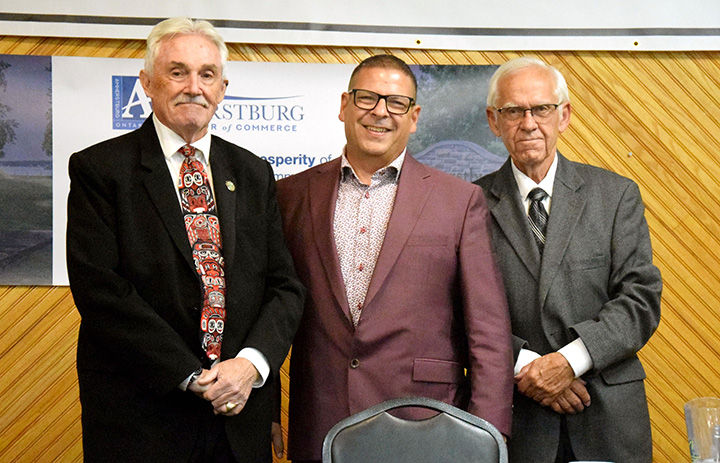
Things got interesting in a lengthy debate between the three mayoral candidates last week.
The Amherstburg Chamber of Commerce (ACOC) hosted the debate between incumbent Michael Prue, Chris Gibb and Bill Fryer Oct. 8 at the McGregor Columbian Club with numerous issues coming up from moderator Michelle Maluske of CTV Windsor.
Opening statements saw the candidates outline their backgrounds, with Prue noting he and wife Shirley moved the area 17 years ago. He said he received a call asking him to run for council eight years ago and was elected as a councillor, doing it because “the town was in bad shape.” Four years ago, the same people asked him to run for mayor and he did, adding he has done his best for the people.
Gibb said his whole life has been in Amherstburg, including meeting his wife and raising his family here. He said he opened a business here and has been involved with boards and organizations like the ACOC, The House Youth Centre, Amherstburg Community Foundation and Marsh Historical Collection.
Fryer noted he was born and raised in Amherstburg, coached sports for 45 years and was a member of the AAM Volunteer Ambulance Squad. His policing career began as an auxiliary member in 1969 and he worked his way up to being the chief, a position he served in until 1998 when he retired. He then worked 13 years at the casino in Windsor.
As for what constituents can expect from them, Prue said in his case he has 34 years of experience at the municipal and provincial level and tries to be honest and forthright. He said as mayor, debt has been paid down and the town has more money in the bank. He suggests that if the town were to switch to OPP policing, there could be upwards of $3 million in savings to use elsewhere.
Gibb said all seven members of council are a team, and emphasizes a “we” philosophy. He said all seven members of council need to collaborate and wants to see ideas come together in an actionable plan. He believes he can bring people together to find Amherstburg solutions to Amherstburg issues and wants to bring that skill as the next mayor.
Fryer said when he was police chief, there was a need to change the structure of policing. He said the service went to a community-based policing model and he undertook such initiatives as new uniform colours, additional bike patrols and more foot patrols. He said he “led the team the way it had to be led” and would seek to run town council the same way.
Achieving a balanced budget by capping taxes and possibly cutting services was asked, with Gibb stating the town is a $65 million corporation with $1.7 billion in assets. He questioned the ability to run the corporation by capping taxes, but said they can cut taxes but noted there is a lot of work to be done in Amherstburg. Taxes can be managed and stabilized but the town also needs to look long-term. Municipalities that have zero per cent increases often raid reserves and try for short-term gain.
Fryer said while campaigning, he ran into a couple that moved here from Ottawa and told him their taxes are higher in Amherstburg. He said he can’t believe the town is in that position.
“I don’t know what the answer is in controlling it. There has to be a way,” he said. “I don’t have a clue until I see the figures and know what I’m working with.”
Fryer added he doesn’t know how anyone can say there wouldn’t be an increase because of the work that has to be done. He added the town’s infrastructure “is in terrible shape.”
Prue said the town was “in terrible shape” 15 years ago and two levies had to be added to bring in additional revenue. He said the town is still paying down debt from then and the town doesn’t have a choice. Prue wants to see more commercial and industry, adding they are “hoping to hear” something happen regarding the former Diageo plant by the end of the month.
Gibb added the current council and previous councils have worked hard to address infrastructure needs and are continuing to address it. He said it is getting better and it is being done through continued investment. Fryer noted the rural areas need work and he has listened to “horror stories” about their infrastructure. Prue said taxes have gone up 19 per cent in five years with inflation being 17 per cent in that time, but noted the construction price index has “skyrocketed” in that time.
The Heritage Conservation District (HCD) was a topic with the question being how it can be leveraged. Fryer said he needs to view it more closely and heard stories about the HCD and closing Murray St., something he doesn’t agree with. He said there can be an HCD but he didn’t think he could answer the question properly.
Prue said the town failed to establish an HCD in 20 years and said he made it a priority to succeed this term. He said that has seen 165 homes protected, and pointed out the history behind it. The history makes Amherstburg unique provincially and the town has received awards for his work protecting history. Regarding Murray St., he said it was one person’s idea for an “Anchor District” and council did not cast a vote to do that.
Gibb said all of council voted to establish the HCD and it is “working very, very well.” He said it is to protect the look and feel of a neighbourhood but not stand in the way of people improving their home. Gibb said he has been on the heritage committee and applications are being approved because people want to preserve their neighbourhoods. Complaints are few and it is “one of those Amherstburg success stories because we compromised and we worked together.”
The best choice for policing was another question asked, with Prue reiterating his support for the OPP. He said council charged him to look at five options, noting LaSalle “could not take us” and work within the timeframe. There was not enough support at the county level for a regional service, the town went back to Windsor but that didn’t work out and it was too expensive to restart Amherstburg policing as all of the equipment “is gone.” He added while the OPP hasn’t given figures to Amherstburg yet, he said costs per household are cheaper in surrounding municipalities than current costs in Amherstburg.
Gibb said the town can’t make a truly informed decision without costings from Windsor on the current level of service or a service with fewer amenities than what is offered now.
“I don’t understand how we make that decision,” he said.
Gibb said he hears from people that are upset that the town moved away from Amherstburg police but believed they would move further away from that by going with OPP. He said OPP would provide adequate policing but that would be a regional model versus community policing, which would be different for Amherstburg.
“We cannot make an informed decision until we have all the options,” he said, adding he doesn’t feel they have fulfilled a promise to the residents by not getting more information from Windsor.
Fryer said it his opinion that it would “cost a fortune” to restart Amherstburg police and it would cost less for OPP.
“If we are going to continue to pay for Windsor or our price is going to go up for Windsor, I’d like to know what we’re going to get,” said Fryer. “I really don’t see much at this point in time. We have homes in McGregor that have never seen a police cruisers. We have places in Malden that have never seen a police cruiser.”
Fryer said the level service removed from Amherstburg in the switch to Windsor hasn’t been maintained, in his view. The OPP would be a designated detachment in Amherstburg with a service board or committee but it wouldn’t be as good of a service as Amhesrtburg. Fryer said there needs to be input from the residents.
Prue agreed with that, but said “it’s gone.”
The town got a “terse letter” from Windsor stating they didn’t want to continue the current contract and accused members of Amherstburg council of going to Windsor “to try and make a deal.” Council members were “livid” to find out that was going on. Prue said the tough choice was the OPP.
Gibb said there were days when someone has to stand as an individual because “something is not right.” He couldn’t tell people why there was no costs from Windsor “because it was all secret.”“We were able to force a public conversation on that. Now we all know where everyone stands. That is being responsible and being accountable and responsible to the voters and residents of Amherstburg. I don’t apologize for it and I’d do it again,” said Gibb.
The best selling feature of Amherstburg to make a person or company wanting to invest in town was posed to the candidates. Gibb said Amherstburg is “the best community in all of Ontario” with a fantastic character and small-town feel.
“There are people who have chosen to live here because of our sense of community,” he said.
Commercial investment is seen through nearly no empty storefronts, a growing Chamber of Commerce, a lot of people working from home, and additional high speed internet options.
“This community is thriving. Investors see that. That’s why they’re buying our buildings, that’s why they’re locating here,” said Gibb.
Fryer noted the town should reach out to businesses and companies to attract them to town. He suggested incentives to bring corporations to town. He said there are homes for sale all over town, but infrastructure has to be repaired to bring in more people. Hydro is still an issue so companies are assured they have a steady flow of service.
Prue said Amherstburg is one of the safest communities in Canada, has quality schools, access to higher education in Windsor and a history “we all can be proud of.” People use the word “quaint” to describe Amherstburg, he said, and there is a skilled workforce locally. He added 17 per cent more people have been employed in Amherstburg than in the last two years but called for more industrial development.
Gibb added the province even sees the value of what is happening, noting funding for the Howard Industrial Park with Prue stating he worked with provincial ministers and Essex MPP Anthony Leardi to make it happen.
The future of the town hall building was raised with Fryer stating once the fire station is empty, renovations could take place. He said a costing could be obtained, adding he couldn’t see the town building a new town hall or leasing in the former high school. He said he would have to see the books to know how to pay for it, but didn’t know how they could bill the taxpayers for a new building.
Prue said rebuilding or renovating the current town hall isn’t viable, stating it wouldn’t work from a cost perspective and that there still wouldn’t be enough parking. He refuted a suggestion he recieved that the town could buy additional properties around town hall as that would displace local families. Saving money, working out of town hall and then explore building or leasing could be explored.
“It doesn’t have to be in the next four years but it does have to be soon, at some point,” he said.
Going up a floor wouldn’t work, he added, as engineers have said the building isn’t structurally sound for that.
Gibb said the current town hall is over 60-years-old and is not accessible. He said there is a reason old buildings are replaced with new ones. He compared it to an old car as the day comes to where the owner is putting in good money after bad to keep it going.
“That’s where we’re at with our town hall,” he said.
Gibb believed the property is too valuable to be a town hall and it could be sold to someone that would pay property taxes. He said a new town hall could be phased in by building a portion, paying it off, then adding on to it.
What worked well over the last four years and what different things would happen governance-wise was asked. Prue said when council wasn’t at “loggerheads” with each other, things went well citing the Official Plan and other planning issues as example. He said council was often divided on how to spend money with him voting to break ties. Prue said voters have to be careful of who to elect as councillors and voters have to make sure they are in cadence with one another. If they can support a common idea, things will work well.
Gibb said the last four years were “a transition” for Amherstburg, stating the community went from being scared of the future to one that planned for the future and went from being reactive to proactive. He said they have plans in place to “boldly move into the future” and over the next few years, they have to execute on that.
The town’s finances are not perfect but have improved substantially, Gibb indicated, and said now is time to “build the Amherstburg we all want while we preserve what we have.”
Gibb added Amherstburg’s best days are ahead and he wants to be part of it.
Fryer said he has been to some of the more recent council meeting and listened to a lot of conversations. He said the strategic plan for the police service was in the training manual at the Ontario Police College. He said he didn’t know how the town would go into the future without winning a jackpot because “lunging ahead” would “cost us a fortune.”
If elected, Fryer would want a council that works together and move forward, adding he has no problem moving ahead with plans previous councils have started.
A question over how public life can be demanding on personal lives and families was first addressed by Gibb. Gibb said as the current deputy mayor, he has developed a thick skin and worked hard to communicate with residents of Amherstburg. He believes he can continue to do that. He said “we can roll with it” if someone has a bad day and has the personality to let things roll off his back.
“We not a divided community,” he said. “The doors I’m knocking on, people are incredibly positive and looking for the future. We have to put the negativity behind us.”
Gibb said the town shares a 230-year history and it can manage current issues, adding “it’s a family” that can work together.
Fryer said he didn’t have to run for mayor and noted “you have no idea how thick my skin is.” He took an oath of office as an officer and had to carry it out, and had to work for the taxpayers, Fryer added. He said there are things that have to be fixed “and I know how to fix them.”
Prue said he has been married to his wife over 50 years and they are still happy with two having careers. He said his wife is either chair or vice chair of three town committees because “she is extremely talented.” She was a public employee, now retired, and both have had busy lives but still have found time to be together and balance their lives.
Fryer joked he has been married 61 years, does a lot of cooking and his wife looks forward to him not being home so she can cook.
Key areas of focus and goals the candidates would bring forward as the population grows was asked. Fryer said his vision would be to have a strong council that does the things to provide for the future. He said the current strategic plan is likely a great tool, but his vision is to re-establish a unified community. He said in his door-knocking around the community, he has heard “quite a few negative comments.” He said he hears about things he wants to fix and he has “a certain method of doing it.”
Fryer said there is a list of things that have to be done and that list will be achieved.
Prue said the town needs to be in the best possible financial shape it can be, stating federal and provincial grants are lowering. Enticing business to come to Amherstburg is key, he added, and residents have to be shown they are getting good value for tax dollars.
The town is “blessed,” Prue added with history, environment and everything a person would want in a town.
“We have everything that is necessary for our quality of life,” he said, stating politicians have to ensure the town maintains that.
Gibb said he would like to address the long-term tax stability of the town. He said he hears a lot about the “necessary evil” of taxes. He said they also have to have the culture to address problems early and reject the concept of kicking problems “down the road.” Gibb added revenues need to be expanded by building out the Howard Industrial Lands, which are almost 700 acres.
Gibb envisioned the Howard Industrial Lands as a second version of Oldcastle with jobs and a tax base that provides relief to others. He also called for the town to shift from a seven-year capital budget to a ten-year capital budget.
Should the town have a budget shortfall, candidates were asked what services could be trimmed. Prue said his initial priority would be to protect the vulnerable in the community before doing other projects. He said places like food banks and the mission have to be maintained “so people don’t suffer.” Infrastructure projects could be delayed as they can be fixed in the future, “human beings can’t.”
Gibb said it is law the municipalities have to balance its budget each year. Individual projects may have shortfalls, but he indicated reserves could be used for that and expenses that would be unexpected. As for what services would be cut, the entire council would have to agree on it because everyone has opinions on what is essential and what isn’t.
Fryer said he hasn’t had an issue of a budget shortfall, adding early in his tenure as chief he was asked to go over-budget so his budget could be increased. He said if there was a shortfall, he agreed with Gibb that it would be up to council as a whole. If there are services that can be cut, he was confident they could arrive at a solution.
Asked if art and culture added value to Amherstburg, Gibb said they have always been “one of the core parts of Amherstburg.” Gibb said there are numerous places that promote culture and art, and it helps residents experience culture in their own home town. He said he loves the way business owners are coming forward to offer walls to beautify the town. History is prevalent in the town with some of the oldest buildings in Ontario here, acknowledging some need to be repaired. He added “there are an incredible amount of artists and craftspeople in this community.”
Fryer stated he’s been in Amherstburg his entire life, he has seen people come into go to museums and he knows about the town’s history. He said young people go to a lot of the museums and work at them, adding he has also gone to the Gibson Gallery to learn more about history. He recalled some of his own history, including “the Eleven Months of Hell” that occurred in 1970.
Prue said all great countries and communities have art. He noted he attended two recent unveilings of murals, both by Amherstburg artist Dylan White, and they are both “stunning.” He said he collects art and wants to recognize all different cultures and its art, including dancing and music. He said he wants to see First Nations honoured and wants a statue in town. The town needs to showcase the brilliance and culture of its people, adding he thanks local entrepreneur Richard Peddie for spearheading a lot of work downtown.
Mechanisms to attract new business and encourage local entrepreneurs was asked. Fryer said there is an obligation for town council to attract and support any business or entrepreneurs in the community, stating it would be a negative if they didn’t do that work.
Prue pointed out the Community Improvement Plan (CIP) gives incentives to incoming businesses including tax incentives. He said he helped convince the County of Essex to do something similar. He added the town has to improve access to water and electricity, adding they still need to bring more hydro and water to McGregor and other areas. The IESO says the town won’t get more power for up to eight years, so the town has had discussions with Enbridge about gas fire generation.
Gibb said businesses can be supported and attracted through land use planning. He said he hears complaints from business owners about the lack of retail space, as the town has a good problem about full commercial units. He said the town can make sure planning and the Official Plan shows where commercial uses can go, stating Alma St. is starting to see more businesses. He added council and the mayor have to be visionaries and ensure land is properly zoned with necessary services.
Reinstating emergency sirens was asked, with Prue stating the Province of Ontario doesn’t recommend them and won’t fund them. Not everyone has cell phone service, he acknowledged, and said the fire department has recommended not going back with them due to people not knowing what they would be sounded for. Prue said if a siren would have a specific use, he would entertain the idea, but it would have to be funded locally.
Sirens are an interesting topic, said Gibb, but said council passed a motion to look at two sirens. He said an incident with Fermi II has a lower likelihood than a tornado, and wanted to make sure rural areas are looked at as well as the urban parts of town. A whole town system would cost $2-3 million he said, and said sirens still require follow up so residents know what to do if they go off. He preferred using the money on getting better cell service in town.
Fryer said he sat on the emergency planning commission with Councillor Diane Pouget and then-fire chief Rick Murray. He said Fermi II was going to contribute to the cost of the local siren system, and said there are people who deserve notification but don’t use cell phones. He said he didn’t know who would pay for them, “but I know we need them.” He recalled training exercises involving local schools and the public and the committee did trial runs to educate people on what the sirens were for.
The issue of strong mayor powers was raised, with Gibb calling them “incredibly anti-democratic.”
“There are seven members of council who have to make decisions. We can’t short circuit that process just for the sake of convenience,” he said.
Gibb said a consensus has to be obtained by all members of council and giving one person power to overrule is not democratic. He acknowledged there are powers that have to be used, such as the mayor having to present the budget. Using the powers beyond that is insulting to council and the voters who put them there, Gibb added.
Fryer said strong mayor powers should be available to mayors but they don’t have to use them.
“Whether I want them or don’t, my answer to that would be I’d probably take them and only have them so you have them,” he said.
Fryer added “there may be a decision that has to be made he doesn’t want council involved in.” He said a decision may have to be made that he doesn’t want council to be accountable for, just the mayor.
Prue said when he received strong mayor powers, he had a document drafted to denounce them. He doesn’t use them, he said, except for a legislative obligation to use them to present the budget. From there, he said he made it council’s budget after turning it over to council.
The powers are revokable, Prue added, as that’s the way the legislation is written. He said he won’t use them because the people elect the entire council and the mayor should only have one vote.
Open Air and tourism and whether they are part of the town’s economic strategy was asked. Fryer believed there should be revisions to Open Air and that streets shouldn’t be closed for 14 weekends. He said Dalhousie St is a thoroughfare and while he has no problem closing a street for a function or event, he doesn’t want to see streets closed every weekend for 14 weeks.
Fryer cited the Navy Yard Park extension as an example of where events could go.
Prue said the town’s economic development officers and the committee says it is good for the town and an economic driver to the downtown core. He said it is funded provincially, with the province having a branch advocating for tourism. The province and regional tourism agencies praise Amherstburg, he said, and say it is a location to come to.
The length of Open Air could be changed as could the days it is offered, and Prue indicated the Navy Yard Park and its extension could be utilized.
Gibb said tourism is an industry in Amherstburg. He said people in the region are looking for places to spend their money, adding he knows many young people who work in restaurants or elsewhere in the service industry who have paid for school, bought cars and homes with money they’ve earned from those jobs. Other mayors and deputy mayors are “jealous” of what the town has from a tourism perspective.
Gibb added he attends Open Air frequently and meets people he knows. He added there is no expectation to spend money and is a “community building exercise.” He indicated the event could change and the next council could make a “long-term change.”
The procedural bylaw and resident participation in council meetings was addressed. Prue said a new plan was developed early in the new term about how to participate, with the plan to bring more order to council meetings. He said council voted unanimously to change the bylaw, adding Pouget tried to make changes but council decided it was too early to change it. From that point, council could not legally look at changing it again, he added.
The bylaw has “not worked out well,” Prue indicated, and spoke against the need for a unanimous vote to allow speakers.
“Democracy demands that people need to be heard, not everyone, not every time, but people need to be heard,” said Prue, adding he wants it changed to needing only a majority vote.
Gibb said the procedural bylaw was passed unanimously and a request to reconsider it failed. The town has to “balance different rights” including the ability to speak at a meeting and to know who is going to be speaking. He said he wants to protect the rights of the many, stating Prue changed the agenda requirement to ten days ahead, and people can file a delegation once they see the agenda. Gibb added council can’t have people raising their hands to speak without informing the public.
Council meetings are not public meetings but meetings that are open to the public. He said there has to be order and structure to meetings, and Gibb said he likes the county’s position of having 2/3’s approval to allow a speaker.
Fryer said if the taxpayers are forbidden to speak at a council meeting, formats need to be changed. He questioned why the town wouldn’t want to listen to people who pay their wages. Fryer said the bylaw needs to be changed to accommodate the citizens of Amherstburg.
Gibb called stating that people are forbidden to speak as “over the top” and suggested a committee of the whole where it wouldn’t be a council meeting but a committee of council and would allow for more communication.
Belle Vue was a topic with Fryer stating he would want to find out what benefits there are for the town to retain it. He said if it is not viable to repair, then he would likely want to sell the property or find someone to partner with to repair it.
“I really don’ t think the town is in a financial position to fix the building that has been left to deteriorate,” said Fryer.
Prue said the town buying the home for $1.1 million was “a steal” a decade ago, but administration told council they wouldn’t spend money on it “and they never have.” He said a deal fell through with Amico-Loop but “nothing ever happened.” Another partner hasn’t been found yet but he said he had discussions with a local businessperson who is “keenly interested” in some of the lands. Prue added letting someone develop it while keeping the heritage aspects was an option that should be explored soon.
The town has had its chance to do something with Belle Vue, said Gibb, but hasn’t. He sparred with Prue over the town spending money on the property, stating there were roof repairs from a recent storm, a security system and lawn cutting the town has spent money on.
Gibb acknowledged the previous attempt at a public/private partnership was not successful but another attempt has to be made. He said it is time “to find someone else to do it.”
Prue said the town spent $200 on a camera at Belle Vue and the town cuts grass on its own property and called it a “ridiculous statement” by Gibb that Prue’s comments were untrue about the town not spending money. He added on a $1.1 million asset, there has been no meaningful money done to protect it.
Gibb said it was a “ridiculous statement” to say the town is not spending money on Belle Vue. He said “we’re here because the town bought an asset without thinking it through” and said Prue, who was not on council at the time, was a proponent of that purchase and that it would be restored by fundraising. Gibb added it is time to let the asset go and let someone else take the responsibility of moving it forward.
Prue said people “tried their hearts out” until the Amico-Loop proposal came along and raised money to try and upgrade the building.
The issue of accessibility was raised, with Prue recalling when the law was first proposed he was in the legislature. He said there was a 20-year period to make things compliant, and added the town was “in complete compliance” with the law.
“The fact the Act is weak is not the town’s responsibility,” said Prue.
There is an accessibility committee that gives advice, the clerk attends all AODA conferences, and the town does everything in its power to make things accessible. He said the town can always do more and believed “we have done a great job in Amherstburg.”
Gibb said accessibility and the higher job of barrier-free is a “never-ending journey.” He said the town can always do better but it takes time and money to do these things. Gibb said the town brings accessibility into all the decisions it makes, using the Transportation Master Plan as an example.
“It’s not about doing it tomorrow. It’s about constantly trying to improve,” he said. “We’re constantly striving to do better.”
Fryer said the accessibility issue he hears through social media and other contacts, there are other things that can be done. He said it would be on his list of things to do as there are people who believe enough is not being done. According to other speakers, the town complies with the law but others in the community don’t agree. Fryer said wherever buildings are that need accessibility upgrades, “we should take care of it.”
The fire hall was a question with Gibb stating it has been an issue for a while. He said the true test of a mayor is when things go sideways, noting the contractor has gone “way past the promised finish date.” If the town were to sue them, all construction will stop and the town would actually be taking their insurance company to court. There are completion and performance bonds, but Gibb said those are insurance contracts.
Another option is that while things didn’t go as the town planned, the town can work with the contractor, learn a lesson and get things done. He said it is “a horrible situation” and that everyone wants the hall completed.
Fryer said people in the community are “outraged” over the fire hall, adding it is “a total nightmare for this community.” He said the process will go “on and on” and maybe there were other things that should have been done, suggesting the town should have used the company LaSalle did for their Front Road hall.
Prue said the situation “has been a disaster” and the contractor was chosen via RFP. He said he is disappointed with the company and pledged he wouldn’t allow them to be on the list of preferred contractors to put in an RFP. He added “the town needs a fire hall” and while he voted against going down to a two fire hall system, he respects the vote but “there’s been a lot of lessons learned.”
The full debate is on the ACOC YouTube channel.
Mayoral candidates debate issues
By Ron Giofu


Comments